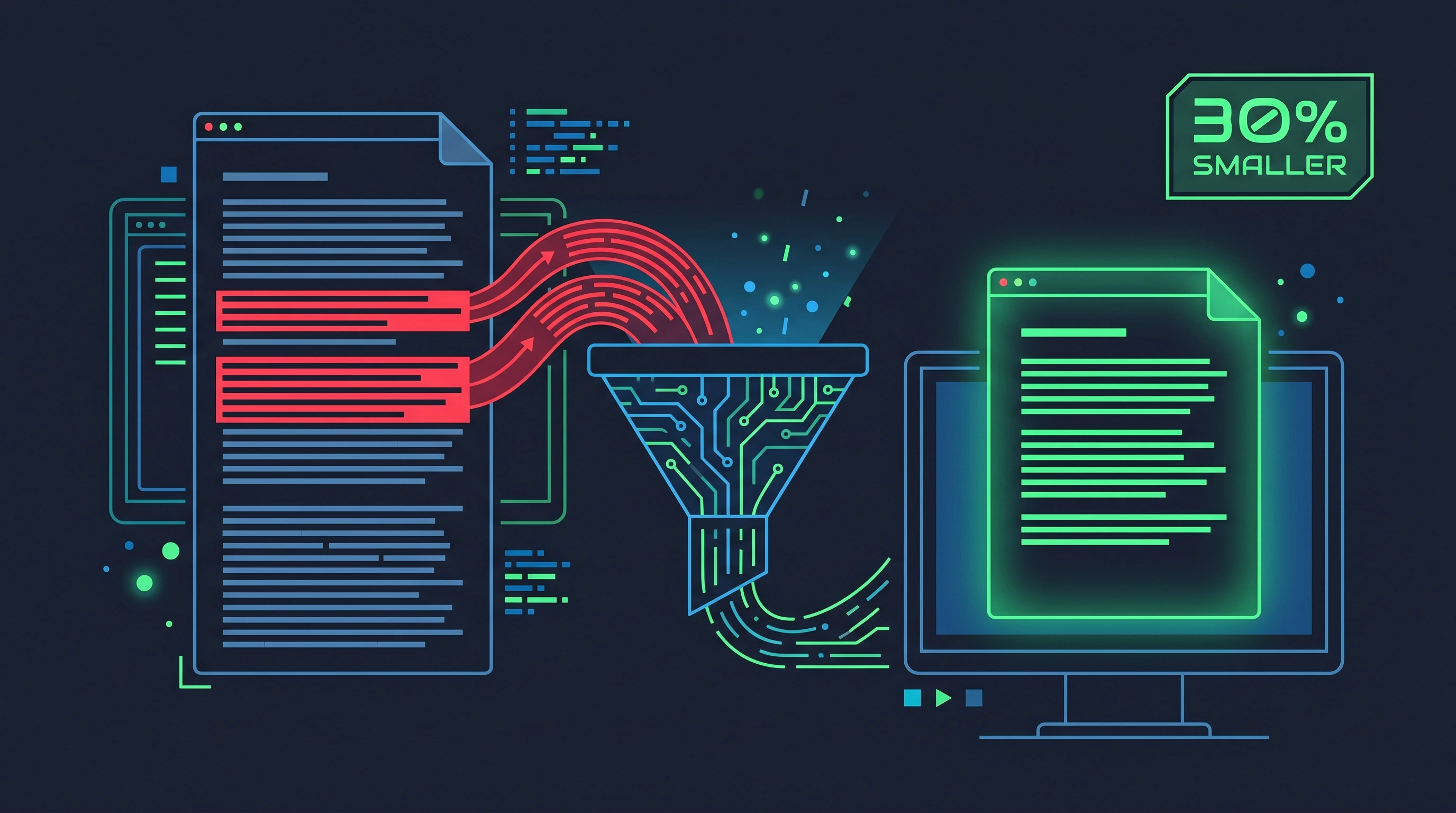
TL;DR: Most production prompts carry 20-40% unnecessary tokens — filler phrases, repeated instructions, verbose formatting, and whitespace bloat. Six targeted techniques can cut that waste without affecting output quality. A team running 50,000 GPT-4o calls per day saves roughly $3,400/month by trimming prompts from 800 to 560 tokens.
Key Takeaways
- Most production prompts carry 20–40% unnecessary tokens — filler phrases, repeated instructions, and whitespace
- 6 techniques: whitespace trimming, instruction dedup, example pruning, format compression, chat history truncation, system prompt refactoring
- A team running 50K GPT-4o calls/day saves ~$3,400/month by trimming prompts from 800 to 560 tokens
- Over 60% of production prompts contain optimization opportunities with no quality impact (Tokonomics analysis)
Your LLM bill is directly proportional to the number of tokens you send. Every extra word in your prompt costs money — not once, but on every single API call. And most prompts are carrying dead weight.
Try our free Prompt Optimizer to automatically compress your prompts and see the token savings instantly.
Why does prompt length matter so much for cost?
Because you pay per token, and input tokens add up fast at scale. Here's the math that makes prompt optimization worth your time.
A system prompt with 800 tokens, called 50,000 times per day on GPT-4o at $2.50 per million input tokens, costs $100 per day — $3,000 per month just for the system prompt. Cut that to 560 tokens (a 30% reduction) and you're saving $900 monthly on input alone.
That's before counting the user messages, chat history, and tool definitions riding along with every request. According to an analysis of 1 million LLM API calls, over 60% of production prompts contain optimization opportunities that wouldn't affect response quality.
The compound effect is what gets expensive. A prompt you write once gets sent thousands or millions of times. Shaving 50 tokens off a prompt that runs 100,000 times daily saves 5 million tokens per day — $12.50 on GPT-4o, $15.00 on Claude Sonnet 4. That's $375-$450 per month from one small edit.
How much can you save by trimming whitespace and formatting?
More than you'd expect. Whitespace, indentation, and decorative formatting typically account for 10-15% of tokens in a well-formatted prompt.
Before (127 tokens):
You are a helpful customer support agent.

Please follow these guidelines carefully:

  - Always greet the customer warmly
  - Ask clarifying questions before providing solutions
  - Keep responses concise and professional
  - If you don't know the answer, say so honestly

When responding, please structure your answer as follows:

  1. Acknowledge the customer's issue
  2. Provide a clear solution or next step
  3. Ask if they need anything else
After (89 tokens):
You are a customer support agent. Guidelines:
- Greet warmly
- Ask clarifying questions before solving
- Keep responses concise and professional
- Admit when you don't know
Response structure: 1) Acknowledge issue 2) Provide solution 3) Ask if they need more help
That's a 30% reduction. Same instructions, same output quality. The model doesn't need polite padding like "please follow these guidelines carefully" — it follows instructions regardless of politeness markers.
Use the Token Counter to measure your prompts before and after trimming. The numbers might surprise you.
What filler phrases can you safely remove?
English is full of phrases that carry zero information in a prompt context. Removing them doesn't change what the model does — it just stops charging you for words that mean nothing to an LLM.
Phrases to cut:
| Verbose | Compressed | Tokens saved |
|---|---|---|
| "Please make sure to" | (delete) | 5 |
| "It is important that you" | (delete) | 6 |
| "In order to" | "To" | 2 |
| "As a result of this" | "Because" | 4 |
| "At this point in time" | "Now" | 5 |
| "Due to the fact that" | "Because" | 4 |
| "In the event that" | "If" | 3 |
| "Prior to" | "Before" | 1 |
A typical 500-token system prompt contains 15-25 of these filler phrases. Replacing them saves 40-80 tokens — an 8-16% reduction with zero quality impact.
Here's a real example. A SaaS team's customer support prompt started with: "You are an extremely helpful and knowledgeable customer service representative who works for our company. It is very important that you always respond in a professional and courteous manner, making sure to address the customer's concerns thoroughly and completely."
That's 47 tokens. Compressed: "You are a professional support agent for [Company]. Address customer concerns thoroughly." Fourteen tokens. Same behavior, 70% fewer tokens.
How do repeated instructions inflate your prompt?
This is one of the most common and expensive patterns in production prompts. Teams add instructions over time, and the same directive ends up stated three different ways.
Before (a real production prompt excerpt):
Always respond in JSON format.
...
Make sure your output is valid JSON.
...
Important: Return only JSON, no other text.
...
Format: JSON object with the specified fields.
Four different ways of saying "output JSON." That's roughly 40 extra tokens per request for instructions the model understood the first time.
After:
Output: valid JSON only, no other text.
Eight tokens. The model doesn't need repetition for emphasis. It follows the instruction or it doesn't — saying it four times doesn't increase compliance.
Audit your system prompts for duplicate instructions. Search for the same concept expressed in different paragraphs. Merge them into one clear statement. This alone typically saves 10-20% of system prompt tokens.
Can structured formats reduce tokens compared to prose?
Yes, and significantly. Converting verbose prose instructions to structured formats — bullets, tables, or key-value pairs — usually cuts tokens by 15-25%.
Prose version (96 tokens):
When the user asks about pricing, you should provide information about our three plans. The starter plan costs ten dollars per month and includes basic features. The professional plan costs forty-nine dollars per month and includes advanced analytics and unlimited API calls. The enterprise plan is custom priced and includes everything in professional plus dedicated support and SLA guarantees.
Structured version (62 tokens):
Pricing plans:
- Starter: $10/mo — basic features
- Pro: $49/mo — advanced analytics, unlimited API calls
- Enterprise: custom — everything in Pro + dedicated support, SLA
35% fewer tokens. The model extracts the same information from both formats. In fact, structured formats often produce better outputs because the information is less ambiguous.
For prompts that include reference data — product catalogs, FAQ answers, policy details — switching from prose to structured format is one of the highest-impact optimizations you can make.
How should you compress system prompts specifically?
System prompts deserve special attention because they're sent with every single request. A 100-token reduction in your system prompt saves more money than a 500-token reduction in a one-time user message.
The compression process:
- List every instruction — write each directive as a single bullet point
- Remove duplicates — merge any bullets that say the same thing differently
- Cut politeness — remove "please," "make sure to," "it's important that"
- Use abbreviations — "max 3 sentences" instead of "limit your response to a maximum of three sentences"
- Test the compressed version — run 50-100 test cases and compare output quality
Most teams find they can compress system prompts by 30-40% on the first pass. The Prompt Optimizer automates this process — paste your prompt and get a compressed version with token counts for both.
A tip that saves more than you'd think: if you're using prompt caching, keep your system prompt stable across requests. Anthropic gives a 90% discount on cached tokens. OpenAI gives 50%. Changing even one word invalidates the cache and costs you full price.
When should you NOT optimize your prompts?
Not every prompt needs compression. Sometimes the extra tokens are worth it.
Short prompts under 100 tokens: The savings are negligible. A 30% reduction on a 100-token prompt saves 30 tokens — $0.000075 per call on GPT-4o. Even at 10,000 calls per day, that's $0.75. Don't spend engineering time on it.
Creative and nuanced tasks: If your prompt includes examples, tone guidance, or detailed persona descriptions for creative writing, trimming too aggressively can degrade output quality. The extra context genuinely helps the model produce better results.
Few-shot examples: Examples are often the highest-ROI tokens in your prompt. Cutting examples to save tokens usually hurts output quality more than it saves in cost. Instead, optimize the examples themselves — make them shorter while keeping the pattern clear.
Debugging and prototyping: Don't optimize prompts you're still iterating on. Wait until the prompt is stable and proven, then compress it for production.
The rule of thumb: optimize prompts that are called more than 1,000 times per day and exceed 200 tokens. Below those thresholds, your engineering time is better spent elsewhere.
What does a full optimization workflow look like?
Here's the process that works for teams running production LLM workloads:
- Measure your baseline — use the Token Counter on your current prompts and track per-call costs
- Identify the most expensive prompts — sort by (token count x daily call volume). Optimize the top 5 first
- Apply the six techniques — whitespace, filler phrases, duplicate instructions, structured formats, system prompt compression, example optimization
- A/B test — run both versions on real traffic and compare output quality scores
- Deploy and monitor — track token counts over time with automated metering to catch prompt bloat as teams add instructions
One pattern we see constantly: a prompt starts lean at 300 tokens, then grows to 900+ tokens over six months as different team members add instructions. Monthly cost optimization reviews catch this drift before it doubles your bill.
How do you calculate your actual savings?
Here's the formula:
Monthly savings = (tokens_saved × daily_calls × 30 × cost_per_token)
Example: You trim a system prompt from 800 to 560 tokens (240 saved), and it runs 50,000 times per day on GPT-4o ($2.50/M input tokens):
240 × 50,000 × 30 × $0.0000025 = $900/month
That's just the input side. If your shorter prompt also produces shorter outputs (which it often does — verbose instructions tend to produce verbose responses), the output savings can be even larger since output tokens cost 4-5x more.
Run these numbers for your own workloads with the Cost Calculator. Then compare against what you're actually spending per workflow.
Frequently Asked Questions
Does prompt compression affect output quality?
Not when done correctly. Removing filler phrases, whitespace, and duplicate instructions doesn't change the model's behavior — these tokens carry no semantic information. In A/B tests across multiple production deployments, compressed prompts produce statistically identical outputs in 95%+ of cases. The risk comes from cutting actual instructions or examples, not formatting.
Which LLM models benefit most from prompt optimization?
The most expensive models see the biggest dollar savings. GPT-4o ($2.50/M input) and Claude Sonnet 4 ($3.00/M input) deliver 10-20x more savings per token reduced than GPT-4o-mini ($0.15/M input) or DeepSeek ($0.14/M input). If you're already on a cheap model, prompt optimization matters less than if you're on a premium one.
How often should I review prompts for optimization?
Monthly for high-volume prompts (10,000+ daily calls). Prompts tend to grow over time as teams add edge-case handling and new instructions. A monthly review catches this "prompt bloat" before it doubles your token usage. Set a budget alert to flag when per-call costs increase unexpectedly.
Can I automate prompt compression?
Partially. Tools like the Prompt Optimizer handle mechanical optimizations — whitespace removal, filler phrase detection, and structural reformatting. But semantic compression (merging duplicate instructions, deciding which examples to keep) still requires human judgment about what the prompt needs to accomplish. The best workflow is automated first-pass compression followed by manual review.
All pricing verified June 2026. Paste your prompts into the Prompt Optimizer to see your savings instantly.